

How to Harmonize Your Vibrational Frequency Through Conscious Mental Architecture
Most people live in a constant state of reaction, allowing their stream of thoughts to determine—without any filter—their quality of life. However, within the Quantum Emotion methodology, we understand that thought is not just a cognitive event, but a radiofrequency signal.
Your emotional state is the indicator of your vibrational frequency; if your thoughts are erratic and dense, your threshold of connection with reality will be low.
To raise that threshold and sustain an optimal vibration daily, it is essential to stop merely “having thoughts” and start architecting them. Harmony does not arise by chance; it is built through conscious observation and disciplined internal language.
The Threshold of Connection: Why Your Vibration Determines Your Reality
From a quantum physics perspective applied to emotion, every thought emits a frequency measured in hertz (Hz). A depressed or anxious state vibrates at a low threshold, making it difficult to connect with opportunities, solutions, and well-being. When we learn to harmonize our mind, we raise that threshold of connection.
This is not simply about “feeling good,” but about reaching an optimal frequency where mind and body operate in coherence.
To achieve this state consistently, the first step is external observation of the psyche. Observing your thoughts requires an act of disidentification: you are not what you think; you are the one who observes the thought.
A fundamental tool for this is written journaling. By putting your thoughts on paper, you transform abstract noise into concrete data. Only when you see that your “negativity journal” outweighs your gratitude notes can you begin the process of reversing your mental polarity.
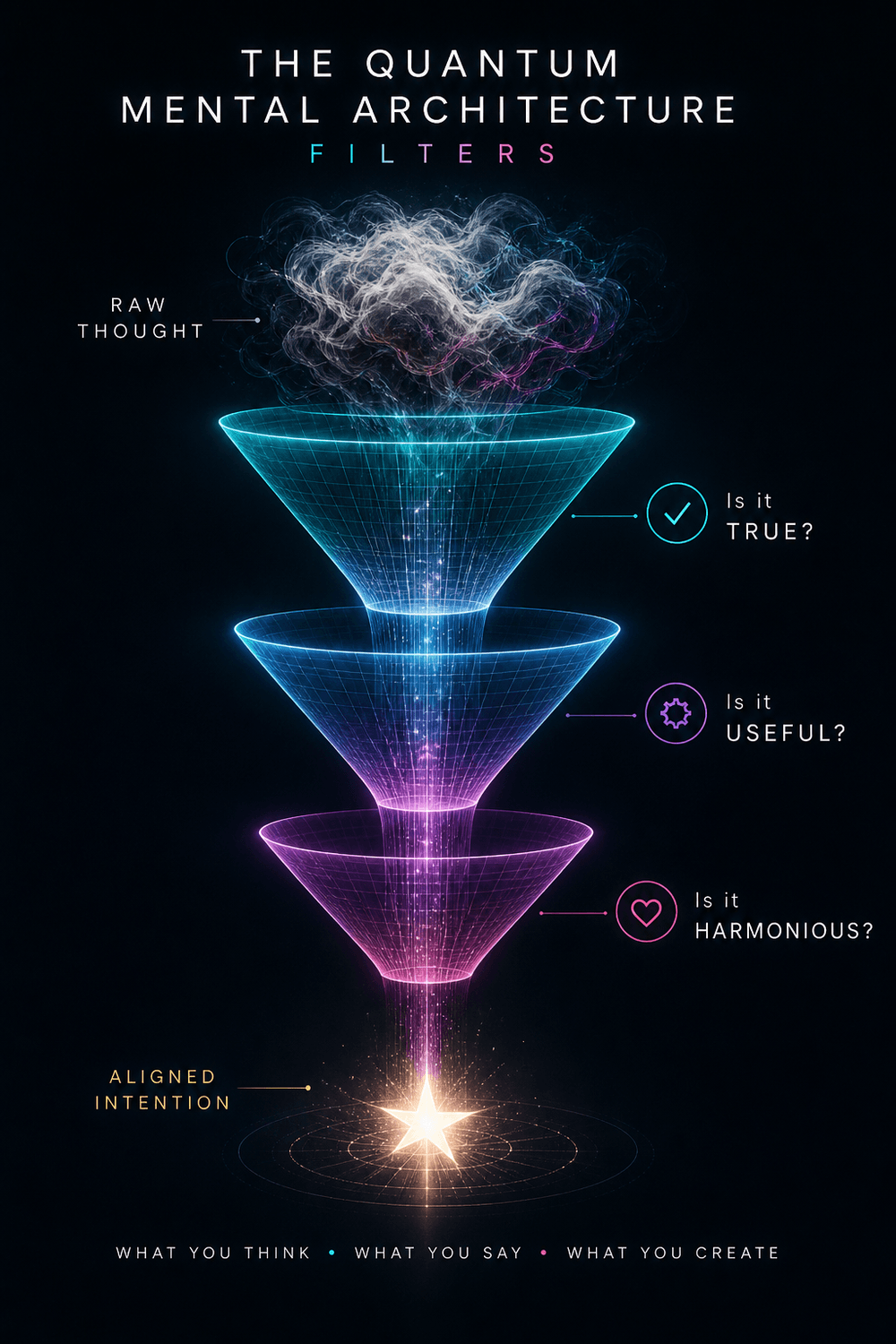
1. The Quantum Filter: The Three Essential Questions
Protecting your energy is essential. If you cannot change your environment immediately, you must strengthen your external mental diet and dedicate more time to meditation and visualization. Your inner world must become stronger than external noise.
To cleanse our mental architecture, we must pass each recurring thought through a three-level filter. If a thought does not pass these three checkpoints, it should be immediately discarded to prevent it from contaminating your emotional field.
Is it true?
We must distinguish between reality and projection. Many of our anxieties are born from catastrophic imagination, not tangible facts. If it is not an absolute truth, it is a distortion.
Is it useful?
A thought may be true (for example, recognizing a mistake), but if it does not provide a solution or learning, it becomes toxic rumination. Usefulness is the foundation of mental efficiency.
Is it harmonious?
This is the key question in Quantum Emotion. Does this thought bring you peace or drain your energy? If the answer is sadness or anxiety, the thought lacks harmony and lowers your vibrational threshold.
“A thought that is neither useful nor harmonious is cognitive waste; learning to discard it is the highest act of self-love.”
2. The Pygmalion Effect and the Language of Self-Love
Self-awareness is the foundation of any real transformation. By exploring tools such as the Enneagram, we are not seeking a label, but identifying the origin of our patterns, our core wound, and fundamentally, our virtue.
However, this knowledge becomes ineffective if our internal language is destructive.
The internal Pygmalion Effect states that we become the label we assign to ourselves. Phrases like “I am stupid” or “I’m useless” are direct commands to your subconscious, programming your behavior.
The way you speak to yourself is the blueprint of your self-image and, consequently, how you will treat others.
Caring for your language is not a matter of aesthetics—it is a matter of personal energy. Changing “I’m terrible for being late” to “I’m sorry, thank you for waiting” transforms the vibration of the moment and preserves your dignity.
3. The Mental Diet: Environment and Sources of Information
Your mind is shaped by everything you perceive through your senses. Your mental diet includes the information you consume, the books you read, and—critically—the social circle you engage with.
High-vibration environments:
If your social circle is focused on complaint and conflict, your vibrational threshold will drop by osmosis. It requires courage to step back and consciously choose who you share your energy with.
Skepticism and a flexible mind:
Do not accept all information as absolute truth. Investigate, go to original sources, and contrast perspectives. Confidence comes from empowered, verified knowledge—not passive consumption.
4. Meditation and Visualization: Designing the Future
The most powerful tool for harmonizing thought is the combination of mindfulness and creative visualization. Meditation through breath calms the nervous system, allowing visualization to become effective.
Do not visualize only the goal—visualize the identity.
How do you walk when you feel capable?
What words do you use in that new role?
What do you wear?
By mentally rehearsing these states with sensory detail (colors, textures, sensations), your brain begins to create new neural pathways. You are training your mind to recognize a reality that has not yet happened—but already vibrates within you.
Frequently Asked Questions About Mental Harmony
Why is it so difficult to eliminate negative thoughts even when I know they harm me?
Because the brain prefers the familiar over the new. Negative thoughts are often linked to deeply ingrained survival patterns. It requires practice and the use of the three essential questions to break biological inertia and create new neural pathways of well-being.
How can I maintain a high vibration if my environment is toxic?
Protecting your energy is essential. If you cannot change your environment immediately, you must strengthen your external mental diet and dedicate more time to meditation and visualization. Your inner world must become stronger than external noise.
When is it necessary to seek professional help beyond self-awareness?
Faith and personal work are pillars, but science is essential. If thought patterns become debilitating, cognitive behavioral therapy and professional mental health support are necessary. Self-awareness and psychotherapy are not opposites—they are complementary for integral healing.
Conclusion: Commitment to Your Inner Peace
Harmonizing your thoughts is a 24-hour practice that requires presence and awareness. It is not a destination, but a daily decision to choose peace over conflict, usefulness over noise, and virtue over wounded patterns.
When you take responsibility for your internal language and your mental diet, your threshold of connection with life naturally rises.
What have you decided to write today in your thought journal?
I invite you to apply the three-question exercise to the thought that disturbed you the most today. Change begins the moment you decide that your harmony is non-negotiable.
If you wish to go deeper into understanding your patterns through the Enneagram and emotional mastery, I invite you to explore my Quantum Emotion methodology.
You can join the course here:
Thank you for being here.
Alex Garcia
Mentor
Quantum
self-knowledge mentoring




© Coaching con Alex García.
All rights reserved.